A Beekeeper's Journal: Everything About Raw Honey
February 22, 2023
by Martine Gubernat
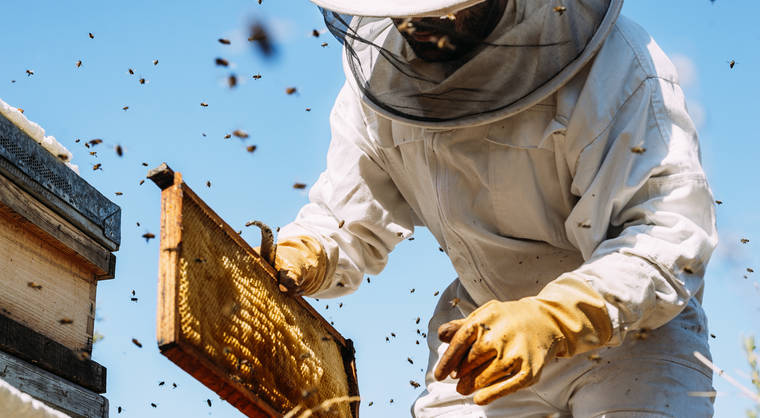
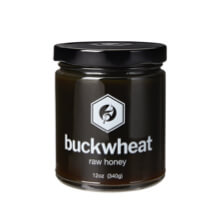
When I first shared with friends that I was taking up beekeeping and honey harvesting as a hobby, one of my neighbor’s kids asked “Why would you want to eat bee vomit?”
Always a teacher at heart, I happily offered to teach him all about honey the following day when he got home from school. He likened it to a “detention” but I called it edification, a lesson in the importance of diction. We also did some honey tasting after the edification, which he liked a lot more. By the time we finished, he thought that the honey bees were “pretty cool.” I considered that tremendous progress! Here is what I explained...
How Bees Make Honey
Honey bees perform a bit of magic when they make honey, which is a multi-step process that non-reproductive female bees work collaboratively to accomplish. During the busy spring and early summer months, honey bees live a relatively short period of time — about 30 days — as they move through a variety of age-appropriate tasks, such as: tending and feeing the larvae and newly emerged bees; building, cleaning, and repairing comb; circulating air in the hive by fanning their wings; guarding the entrance; removing the dead and other debris; and lastly, foraging for water, pollen, and nectar.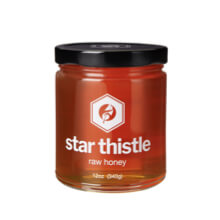
Older forager bees spend the last week or so of their lives searching for flowers that secrete nectar. Once they find an abundant source, they return to the hive to share the location of the nectar source with other forager bees, conveying the specific location where the other bees can find it by doing a special dance.
The forager bees then travel back and forth between the source and the hive, gathering and delivering the nectar. The bees prefer the closest source of good nectar but will fly as far as three miles if necessary in order to find it. They move without rest from flower to flower using their proboscis (a straw-like tongue) to suck the nectar from the flowers then swallow it into their honey stomach, a storage area separate from their digesting stomach. During that process, the bees add enzymes to the nectar, which inverts the complex sugars into simple sugars.
When their honey stomach is full of nectar, they fly back to their hive to offload their liquid gold to the house bees. During this relay, other bees secrete additional enzymes into the nectar and remove more water from it. Passing the nectar from bee to bee therefore makes it thicker before it is deposited in open honey cells inside the hive.
More About Honey
In order to evaporate additional water to reduce the moisture to 16% - 18% so that the honey does not ferment, the house bees beat their wings, circulating the air to dry the honey.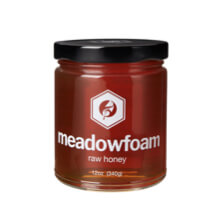
Somehow, the bees know when the honey reaches the correct moisture content and then they cap the cells with wax to keep the honey clean and free of mold; additionally, the bees can walk on the capped cells without contaminating the honey, which is very important to the health and wellbeing of the bees. The inside of the hive is a very clean environment; in fact, the bees never defecate within the hive but rather go on cleansing flights to do their business outside the hive.
Honey bees are hoarders; they store much more honey than they can consume, which is why beekeepers are able to harvest honey, as long as they leave enough for the bees, of course. In NJ, the consensus is that each hive should have at least 60 pounds of honey stores going into the winter.
The bees need to eat that stored honey, a high-energy source of food, when the weather is cold and there are no nectar sources for them to forage in order to replenish their supplies. They also consume honey throughout the more temperate months if there is a nectar dearth, such as during the end of very dry summers when few flowers or trees are blooming.
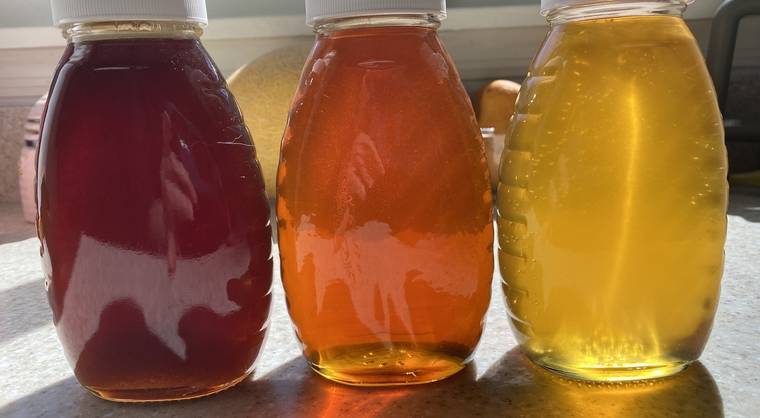
From the Photo Above
Dark amber honey: Harvested in late August through late September, this dark amber honey is likely from goldenrod and Japanese Knotweed plants (also known as Bamboo), both of which grow wild around the area.Amber honey: harvested in late July or early August, this amber honey is likely from Tulip Poplar trees, two of which — 75 foot giants! — grow nearby and are filled with large, tulip-shaped flowers.
Light honey: harvested in late June or early July, this very light honey is likely from Basswood/Linden trees as well as Black Locust trees, the latter of which are abundant in my neighborhood and whose beautiful, white flowers look like popcorn when they fall.