A Beekeeper's Journal: Catching a Bee Swarm
June 07, 2023
by Martine Gubernat

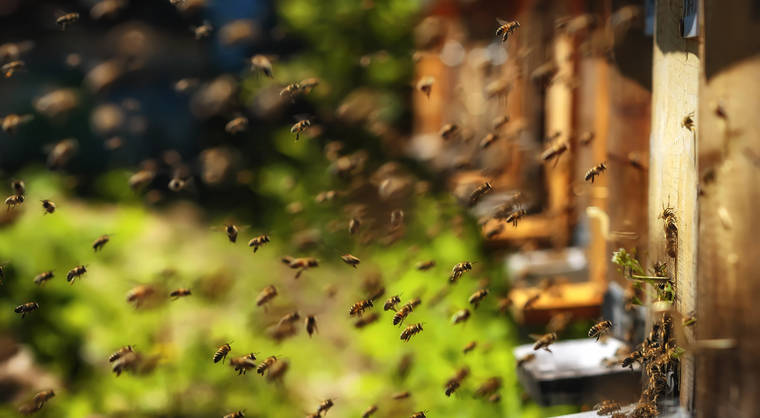
In the bright sunlight, we could see tens of thousands of honey bees flying around our small apiary, with the majority of them coming from hive #4 where they were bearded heavily on the front. Initially we thought that the warm weather was driving the bees outside of the hive because they were overcrowded.
Just as we were about to suit up and add some more boxes with frames to the hive, the buzzing turned into the roar of a tornado as the bees circled into a giant funnel that rose more than 20 feet into the air above the hive. Because we have witnessed swarms before, we knew exactly what we were seeing; unfortunately, we were not expecting a swarm since we had gone into the hive a few weeks prior to reverse the boxes and add more frames of drawn comb so that the bees did not feel crowded.
Obviously, they had other plans.
As the swarm of bees filled the yard, we ran down to the hives and took some videos with our phones – including the astounding sound – to have a record of witnessing the swarm so that we could show others who have never seen, heard, or felt that awesome experience.
To stand amongst those thousands of bees and hear buzzing so loud that we could practically feel the vibrations was both frightening and exhilarating. Once our bedazzlement began to wane, we sprang into action. Just for this very occasion, we had made ourselves a swarm catcher pole after watching YouTube video tutorials. As the bees funneled up and away from the hive, we followed after them, eager to try out our gadget.
Fortunately, they clustered about 10 feet up in a cedar tree on the edge of our property, a height that was possible for us to reach with our swarm catcher — a 16-foot fiberglass extension pole with a plastic, 5-gallon water jug cut open at the bottom and attached to the end of the pole like a basket.
We stood below, watching as the bees formed into a cluster that was bigger than a basketball. The larger the cluster grew, the more hushed they became until our yard was mostly quiet again. As those approximately 10,000-15,000 bees bunched on a branch around their queen, I slipped the swarm catcher pole between the branches until the large, plastic jug was mere inches below them.
The frames of drawn wax comb inside the box offered them a familiar environment. As long as their queen was amongst them, they would remain in the box for a short time until we could contact a beekeeper friend who was happy to accept our honey bee swarm “donation” for the local 4H Honey Bee Club hives. We were gratified to know that our swarm would present a learning opportunity for young children and teens who are interested in beekeeping as a hobby.
This swarm whirlwind happened in about 20 minutes, and we felt fortunate to have stepped outside at exactly the right time to witness this amazing force of nature.
Swarming is how honey bee colonies propagate in nature, so their behavior on this particular day was not unusual; however, beekeepers are never very happy to have swarming hives since they leave with the fully-mated queen and about half of the workforce, leaving behind brood, nurse bees, and worker bees, and a few queen cells so that the remaining colony can raise another queen.
Sixteen days after the eggs were laid, the first queen to emerge will kill the other queens in their cells and begin her reign as the sole queen bee. Seven or so days later, after the queen’s flight muscles grow stronger, she will leave the hive on her one-and-only mating flight, then return to her colony. Unless she becomes part of a swarm the following season, she will not leave her hive again.
Thirsty and excited after our swarm-catching adventure, we came inside to enjoy cold-brewed tea with some Adagio Raw Honey for Fruit Tisanes. This delicate, floral honey was the perfect complement to the tea that we toasted with to celebrate catching the swarm!