What Is Raw Honey? How is it Made?
September 14, 2022
by Lisa Johnson

It All Starts with the Flowers
Now, what really is honey?It all begins with a symbiotic relationship between the honey bee (Apis mellifera) and flowers. The bees and other pollinators are after the nectar and the plants need their pollen moved by all the pollinators. This relationship is called mutualism. The flowers entice the bees with a wide variety of shapes and colors. Some flowers like poppies use ultra-violet wavelength markings that only the bees see to encourage pollination. The true reward for the bees is the nectar. Nectar is the carbohydrate that bees desire. It is composed of two simple sugars, fructose, and glucose. The nectar also has the complex sugar, sucrose.
Each plant produces its unique nectar and flavor. As we know, certain plants grow in certain environments with their own unique climate. That climate is based on its rainfall. So, in a desert environment, the climate is dry, so we expect the nectar to have a lower water content and a higher sugar content. On the flip side, in a moist climate, the plants will produce a higher water content nectar with a lower sugar content. The nectar also contains minerals, vitamins, amino acids, and aromatic esters. These particulars are responsible for the unique taste of that flower’s nectar.
The bees that enjoy that nectar’s flavor and will only forage to that bloom. Beekeepers call it floral fidelity. This is how beekeepers can harvest varietal honey. For example, a way that beekeepers ensure floral fidelity is to put hives in an apple orchard for pollination. The bees will only pollinate those apple blooms curating the apple blossom’s flavor. In the end, that honey harvested will be called Apple Blossom honey.

Pollen – the Protein Source for the Honey Bee
The process of transforming nectar into honey revolves around bee biology. The bees’ only food is nectar and pollen. Therefore, the bee has evolved their biology to become a transport vessel for its food.For example, bees have hair on their bodies which captures pollen. The bees then groom and store it on their hind legs. They have a specific “pollen basket” (known as the corbicula) on their hind legs to transport pollen back to their hive.
Once in the hive the pollen is passed to other bees to store in the wax comb next to their brood (honey bee babies). The pollen is the protein source to feed the colony.
How Nectar Flies to the Hive
The next specialized biological feature the bees use to transport food is their nectar crop.This area of the bee is located directly below the esophagus and above the digestive tract. There is a one-way valve called the proventriculus valve that stops anything from the digestive tract going into the honey crop.
Yet if the bee needs energy from the nectar the proventriculus valve can open allowing only nectar to flow into the ventruculus (mid gut). This honey crop holds between 25 – 40 mg of nectar.
To forage for this amount of nectar one bee must visit up to 500 flowers. So, the old saying, “busy as a bee” really fits!

The Beginning of the Transformation
Once the bee’s honey crop is full, it returns to the hive.This forager bee must wait for one of her sisters to come unload her nectar. Her nectar load is siphoned off by the hive mate’s tongue (proboscus) and down her esophagus and into her honey crop.
This is an interesting phenomenon because each time this honey transfer happens enzymes like invertase are added to the nectar. The addition of enzymes from the bees physically changes the properties of the nectar.
This heralds the beginning of the nectar changing into honey. Each time the nectar is passed to another bee that nectar is subjected to the honey crop.
Within the honey crop are microbial commensals. This then produces antimicrobial acids and peptides that are imparted to the nectar.
Now we call it Honey
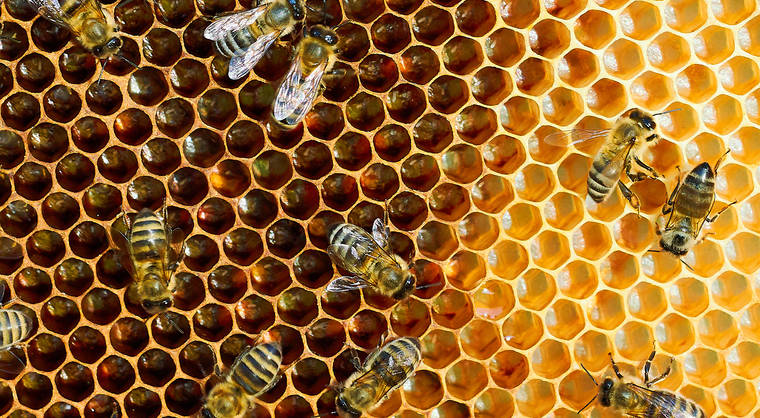
The nectar isn’t honey quiet yet. Nectar has water in it. Up to 80% of water can be present in the nectar. Honey is between 17% – 18% water. This means the bees must evaporate off all this water. The evaporation process happens when the bees pass the nectar to each other. With each transfer the drop of nectar is stretched out between their mouths (mandibles) creating greater surface for evaporation to take place.By time this drop is placed in the cell of the wax comb, it is about 30% water. It is very close to honey but not quite. The bees will start fanning their wings over the cells. Using heat from the colony, the rising heat passively evaporates the water down to 18%. This is when the bees cap the honey. Capping honey is when the bees put wax and seal each individual cell containing honey.
The true transformation of honey must have all of these steps. The nectar has additional enzymes added like invertase which originates in the bees salivary glands. Additional substances are found from the nectar being in the honey stomach. These additives to the nectar begin the physical change into honey. The main chemical change within the nectar happens when the enzyme invertase splits the disaccharide sucrose into simple sugars of fructose and glucose. The last change is with the evaporation of the water in the nectar. Capped honey will only have 18% water.
By having low water content, high sugar content, enzyme content and low pH, honey does not spoil. With the antimicrobial properties it inhibits the growth of bacteria and prohibits spoilage. This is why the honey found in the pyramids was still good to eat!
And there you have it, step by step from the flower all the way to the jar- that is the amazing process of how we get honey!